
4. Provide a functional and technical description of your technology.
This description should answer the core question: “How does your technology work?” Describe the technology in sufficient detail to provide an accurate and factual understanding of its theory, functionality and operation. If appropriate, submit an overall schematic of the technology to [email protected], with a reference to your short title and application identification number in the subject e-mail. (Limit 2500 characters)
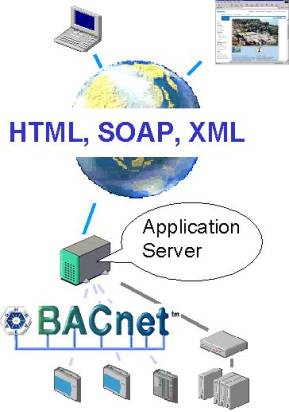
Open Energy demonstrates the BACnet module for Drupal. The BACnet module is free, open source software that was released on September 23, 2014 as Version 7.x-1.0 after a lengthy period of development and testing by members of both BACnet and Drupal communities. The BACnet module embeds real-time data from BACnet systems as energy dashboard type features into Drupal based websites. The features include real-time displays of dynamic text, dials, graphs and charts.
The BACnet module installs like any other contributed module for Drupal. Once installed there are configuration screens to gather addressing details to establish connection with BACnet server(s). Interoperability between Drupal and BACnet servers is established using BACnet Web Services. BACnet/WS was first introduced as addendum c to ANSI/ASHRAE 135-2004 BACnet/WS Web Services Interfaces and details the use of the Simple Object Access Protocol. SOAP is presently the web service defined in the most current release of BACnet (ANSI/ASHRAE 135-2012) in ANNEX N.
The existing ANNEX N, BACnet Web Services, was designed for simple data exchange and simple history retrieval for simple clients. More sophisticated clients and use cases, such as those needed by the Smart Grid, required the addition of more capable services. A proposed RESTful web services solution was published APRIL 2014 as a First Public Review to add new services that provide structured data exchange, full history retrieval, and subscriptions. The BACnet module for Drupal provisions for both SOAP and RESTful BACnet/WS to connect to existing BACnet Servers and those that will be upgraded and installed over the next several years.
The BACnet module is available for the current version of Drupal (D7) and developed in a manner to easily transition to D8 when that is released over the next year. Existing Drupal websites can download and setup the module directly from within the Drupal admin user interface. Custom BACnet content types defined by the module are used to create content as nodes. Nodes can be created to extract any point value or trend present on the BACnet server. BACnet data brought into Drupal is stored in cache memory and displayed directly from there. Widgets for Drupal Views are included so that blocks and views can be created and saved for display as complex panels. Keeping BACnet data in Drupal cached memory and out of the Drupal database enables lightweight, data rich web sites.
In short, Open Energy integrates the existing technologies of BACnet and Drupal. It provides a mechanism for building owners to advertise their building data thru their main web sites. Existing Drupal vertical markets include Government, eCommerce, Non-Profit, Healthcare and Higher Ed. They can now easily be enhanced with Energy relevant data. If BACnet and Drupal are already in place, then real-time building data can be integrated as dynamic content into flagship sites at no cost.